

What Is a Private APN and When Do You Need One?
If you run connected devices at any scale, whether that’s a fleet of smart meters, a network of retail payment terminals or a few hundred vehicles on the road, you will eventually hit the same question: how do I get data from these devices into my systems securely, without sending it across the open internet? For many organisations, the answer is a private APN.
First, what is an APN?
APN stands for Access Point Name. It is the gateway between a mobile network and another network. When a device with a SIM card wants to use mobile data, it tells the network which APN to use, and the network uses that name to decide where to route the traffic, which IP address to assign, and what policies to apply.
Most phones use a public APN. Traffic leaves the mobile operator’s core network and goes straight onto the public internet, and the device is given an IP address from the operator’s pool. That is fine for browsing and social media. It is far less ideal for a device that reports sensor readings, processes card payments or controls physical equipment.
What makes an APN private?
A private APN is a dedicated access point configured for a single organisation. Instead of breaking out to the internet, traffic from your SIMs is carried from the mobile network operator (MNO) core to your own network over a private connection. Only SIM cards provisioned for that APN can use it, and the devices typically receive private IP addresses that are not reachable from the public internet.
In practice, a private APN gives you:
- Isolation. Devices are not exposed to the internet, which sharply reduces the attack surface.
- Control of addressing. You choose the IP scheme, including static addresses and your own DNS, so devices slot neatly into your existing network design.
- Policy enforcement. Traffic can be forced through your firewalls, proxies and monitoring before it reaches anything else.
- Predictable routing. Data takes a defined path rather than whatever route the internet offers that day.
- Visibility. Because all traffic flows through one defined point, it is easier to log, audit and troubleshoot.
How does it work?
The journey of a packet looks like this:
- The device attaches to the mobile network using its SIM and requests your private APN by name.
- The MNO authenticates the SIM and matches it to your APN configuration in its packet core.
- Instead of routing to the internet, the core sends the traffic into a dedicated tunnel or link towards your network.
- That link terminates at your VPN gateway, router or firewall, and from there traffic reaches your servers, applications or cloud environment.
The connection between the MNO and your network can take several forms. The most common are an IPsec VPN (quick and inexpensive to set up over the internet), a leased line or MPLS circuit (more predictable performance), or a direct cloud interconnect such as AWS Direct Connect or Azure ExpressRoute. Some deployments also add RADIUS authentication for an extra layer of device or session verification.
The diagram below shows the end-to-end path.
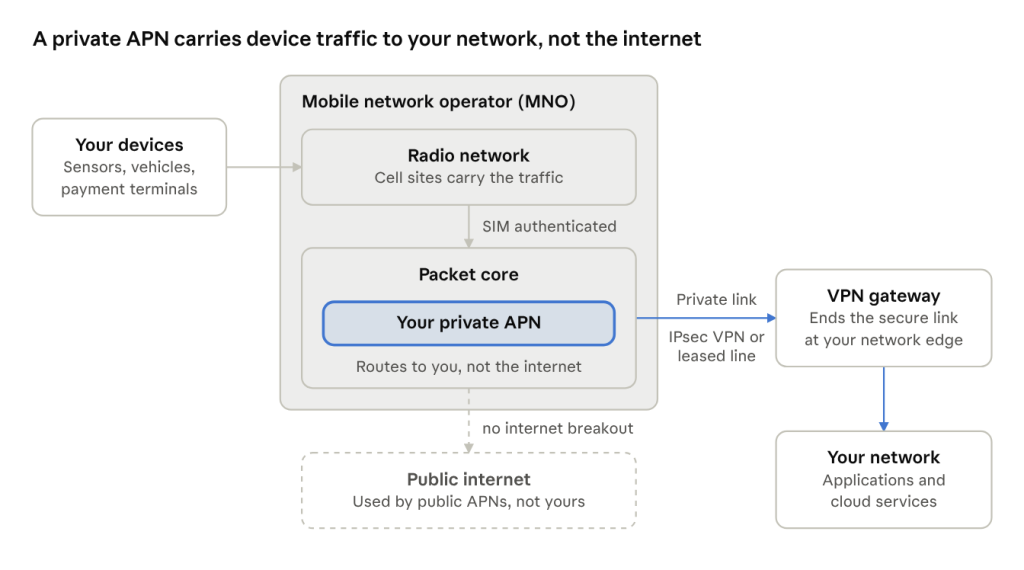
Private APN path · devices to MNO to VPN gateway to your network. Your traffic stays inside the mobile network and a private link, and never touches the public internet.
Where private APNs matter most
IoT and machine-to-machine fleets
Smart meters, environmental sensors, vending machines and asset trackers often live in the field for a decade or more. A private APN keeps them off the public internet, gives each a stable address, and lets you manage thousands of devices as if they were on your own LAN.
Utilities and critical infrastructure
Energy, water and telecoms operators run SCADA and remote telemetry systems where an exposed device is a genuine risk. Private APNs let them reach remote assets over cellular while keeping that traffic inside a controlled network.
Payments and retail
Card terminals, kiosks and ATMs handle sensitive data and must meet standards such as PCI DSS. Routing them over a private APN keeps cardholder traffic away from the open internet and simplifies compliance.
Healthcare
Connected medical devices, remote patient monitoring and mobile clinics need confidentiality and reliability. A private APN helps protect patient data in transit and supports regulatory obligations.
Transport and telematics
Vehicle trackers, ticketing systems and onboard Wi-Fi gateways benefit from secure, consistent connectivity back to central platforms, even as vehicles move between cells and regions.
Remote sites, branches and failover
Temporary construction sites, pop-up retail and branch offices can use cellular routers on a private APN as primary or backup connectivity, landing directly on the corporate network without a separate VPN client on every device.
Video surveillance and public safety
CCTV cameras and body-worn devices generate sensitive footage. A private APN gives you a controlled, private path for that data and the bandwidth predictability that video demands.
Field workforce and remote access
Employees using company-managed phones or tablets can reach internal systems through the private APN, with traffic never touching the public internet on the way.
Things to consider before you deploy
- Connection type. Decide between an IPsec VPN, a dedicated circuit, or a cloud interconnect based on your security, latency and budget requirements.
- IP planning. Agree on an addressing scheme that does not overlap with your existing networks.
- Roaming and coverage. If devices travel or are deployed abroad, check how the provider handles roaming back to your home APN, and whether multi-network SIMs are available.
- Cost and lead time. Private APNs usually involve setup fees and sometimes minimum SIM volumes, so they make the most sense once you have a meaningful number of devices or strict security needs.
- Management tools. Look for a platform that lets you monitor usage, suspend SIMs and change policies without raising a ticket.
The bottom line
A private APN extends your own network over the mobile network. Your devices stay off the public internet, your traffic follows a path you control, and your security team gets the visibility it needs. For any deployment where reliability, privacy or compliance matters, it is one of the most effective building blocks you can choose.