

Enterpise Mobility
Enterprise Mobility and Benefits for Remote Workers are the Mobile Workforce.
Enterprise Mobility has taken over the traditional, desk-bound corporate environment, officially giving way to a hybrid reality. Today, productivity isn’t defined by a physical office, but by the seamless flow of IoT data to wherever a Corporate worker happens to be. This is what we now call Enterprise Mobility and the new era of remote workers accessing Enterprise Applications on Mobile phones, iPads and Laptops. Enterprise Mobility: Corporate remote workers are using Global IoT Connectivity solutions to ensure seamless internet connectivity for their corporate devices as they travel around the globe. Let’s take a deep dive into how the world is changing.
At the centre of this shift is Enterprise Mobility—the strategic use of mobile devices, cloud applications, and secure wireless networks to enable employees to do their jobs from anywhere. For corporate remote workers, enterprise mobility isn’t just a convenience; it is the fundamental infrastructure that enables their work model.
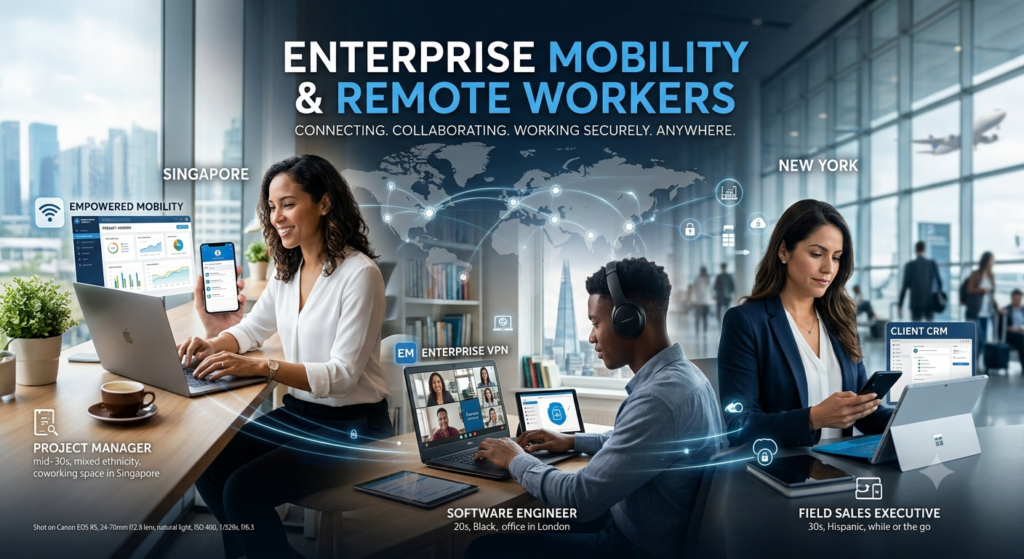
Core Use Cases of Enterprise Mobility
Enterprise mobility is more than just checking emails on a smartphone. In a modern corporate environment, it manifests in several sophisticated use cases:
1. Unified Communications and Collaboration (UCC)
Enterprise Mobility remote workers rely heavily on real-time collaboration. Enterprise mobility integrates video conferencing, instant messaging, file sharing, and project management tools into a unified set of mobile applications. Whether a worker is using a tablet on a train or a laptop at home, they have the exact same communication capabilities as someone sitting in corporate headquarters.
2. Secure Mobile Device and Application Management (MDM/MAM)
To allow remote access without risking data breaches, corporations deploy Mobile Device Management (MDM) and Mobile Application Management (MAM).
- MDM allows IT departments to monitor, manage, and secure employee laptops, smartphones, and tablets.
- MAM focuses specifically on controlling corporate apps, ensuring that sensitive data cannot be copied or leaked into personal applications.
3. Mobile ERP and CRM Access
Enterprise Mobility Sales representatives, consultants, and field executives need access to critical business data on the move. Enterprise mobility extends Enterprise Resource Planning (ERP) and Customer Relationship Management (CRM) software to mobile screens. A remote sales manager can update a client’s profile, check inventory levels, or approve a contract instantly via a mobile device.
4. Identity and Access Management (IAM)
With employees logging in from various residential networks and public Wi-Fi hotspots, securing entry points is vital. Enterprise mobility frameworks leverage IAM tools like Single Sign-On (SSO) and Multi-Factor Authentication (MFA) tailored for mobile interfaces, verifying a remote worker’s identity seamlessly before granting access to corporate databases.
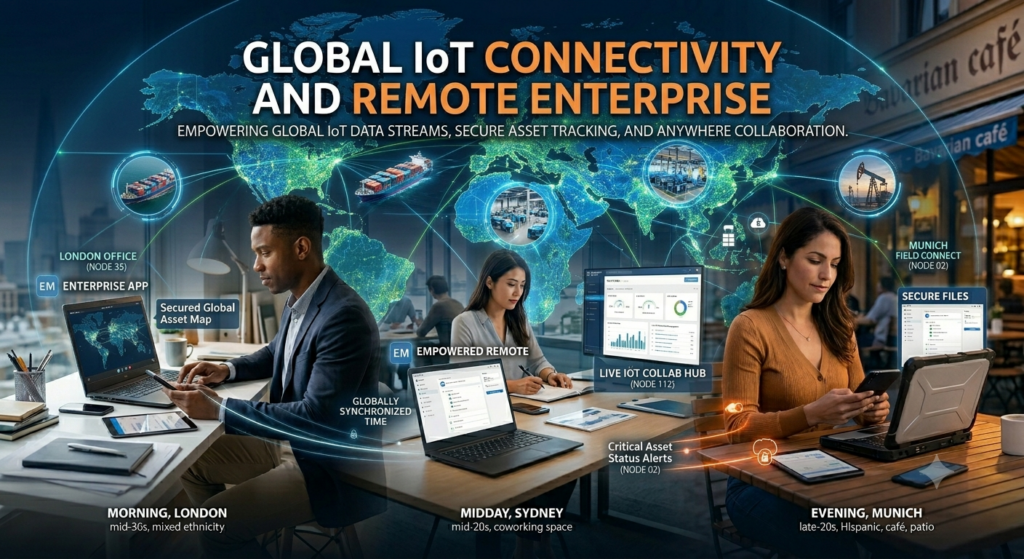
Key Benefits for Corporate Remote Workers
When executed correctly, an enterprise mobility strategy transforms the daily experience of remote employees, driving both personal satisfaction and corporate productivity.
| Benefit | How It Works | Impact on the Remote Worker |
| True Location Flexibility | Cloud-native mobile apps eliminate the need to be anchored to a specific desk or even a home office. | Employees can work from anywhere seamlessly, significantly improving work-life balance. |
| Enhanced Productivity | Micro-tasks (approving workflows, replying to urgent pings, reviewing documents) can be done during gaps in the day. | Dead time is converted into productive time, preventing administrative bottlenecks. |
| Frictionless Onboarding | Over-the-air (OTA) provisioning enables corporate devices to be shipped directly to a remote worker’s home and automatically configured upon login. | New hires are up and running in minutes without needing to visit an IT desk. |
| Reduced Tech Frustration | Modern enterprise mobility platforms feature self-service portals for password resets, software updates, and troubleshooting. | Remote workers don’t have to wait hours for an IT support ticket response to fix minor issues. |
Perhaps the greatest hidden benefit for remote workers is the peace of mind that comes with automated security. Because enterprise mobility tools containerize corporate data, remote employees can use their devices freely without worrying that a personal mistake (like downloading a compromised app) will inadvertently breach their company’s network.
Enterprise mobility bridges the gap between physical distance and corporate cohesion. By providing remote workers with secure, agile, and intuitive mobile tools, organisations don’t just maintain operational continuity—they build a more autonomous, responsive, and satisfied workforce. As remote and hybrid work models continue to mature, the companies that invest heavily in robust mobility strategies will ultimately attract and retain the best global talent.